When you look for Spanish classes, you see codes everywhere: A1, A2, B1, B2… They come from the Common European Framework of Reference for Languages (CEFR), the international standard used by schools, universities and official exams like the DELE. But what do they actually mean for you?
Here is a simple guide, based on what my students can really do at each stage.
A1 · Beginner
You are starting from zero, or you only know a few words. At the end of A1 you can:
- Greet people and introduce yourself.
- Talk about your family, your job and where you are from.
- Use numbers, tell the time and order in a café.
- Understand simple questions when people speak slowly.
A2 · Elementary
You can survive in everyday situations. At the end of A2 you can:
- Talk about your routine, your plans and the past.
- Shop, ask for directions and handle a trip without panicking.
- Have short conversations on familiar topics.
B1 · Intermediate
This is the level where Spanish starts to feel like yours. At the end of B1 you can:
- Keep a conversation going about experiences, opinions and wishes.
- Understand the main points of clear conversations, videos and podcasts.
- Tell stories and explain your plans and reasons.
B2 · Upper-intermediate
You are independent. At the end of B2 you can:
- Talk fluently and spontaneously with native speakers.
- Discuss and defend your opinion on many topics.
- Understand movies, series and the news without too much effort.
After B2 come C1 and C2, the advanced levels, for people who need Spanish for academic or professional life.
How long does each level take?
It depends on your time, your practice and your first language, so these are only rough guides of total guided study:
| Level | Approximate total hours |
|---|---|
| A1 | 80–100 hours |
| A2 | 180–200 hours |
| B1 | 350–400 hours |
| B2 | 500–600 hours |
Practicing a little every day helps much more than studying a lot once a week. Speaking with real people helps even more.
How levels work at Enjoying Spanish
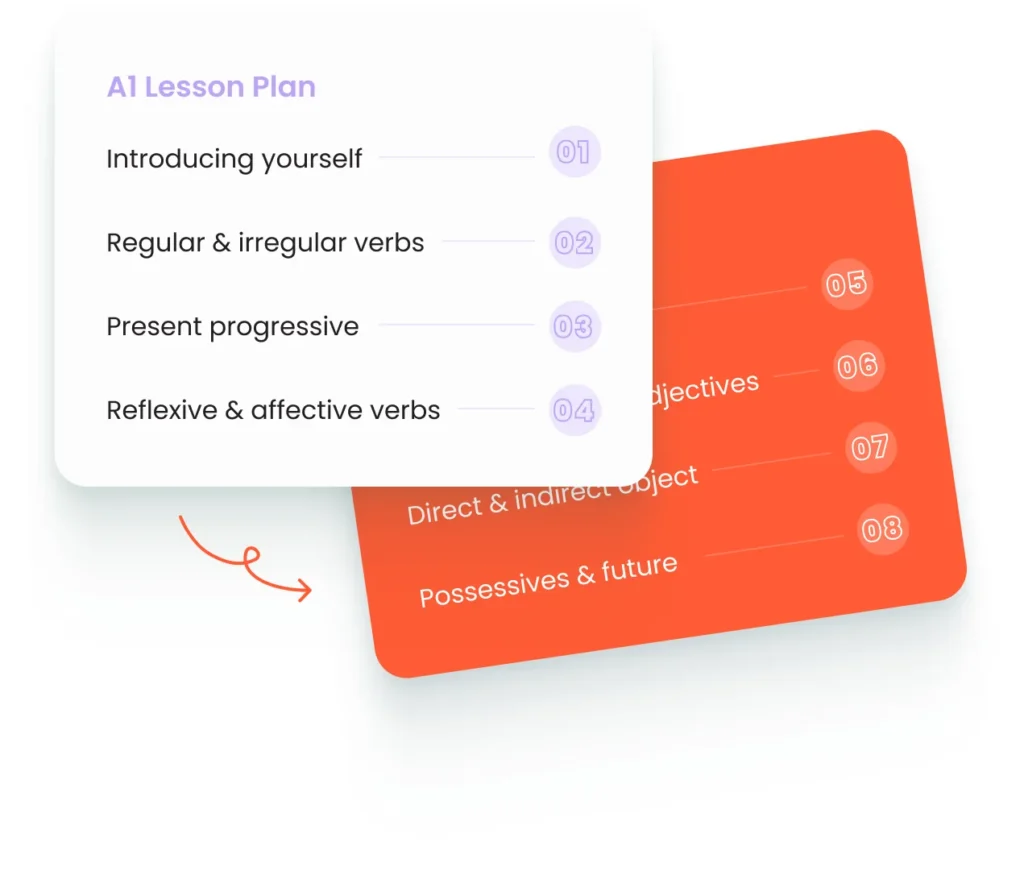
At Enjoying Spanish, every level has 4 chapters, each with its own book, topics and live practice. That way you always know exactly where you are and what comes next. In the hybrid course you learn each chapter with video lessons, your book in PDF, games and homework, plus live sessions with me to practice and ask questions.
Not sure about your level?
Take the free level test. It only takes a few minutes and tells you whether you are A1, A2, B1 or B2. If you have never studied Spanish, you don’t need a test: you start at A1 with everything explained from zero. Then have a look at the courses and prices to choose your format.